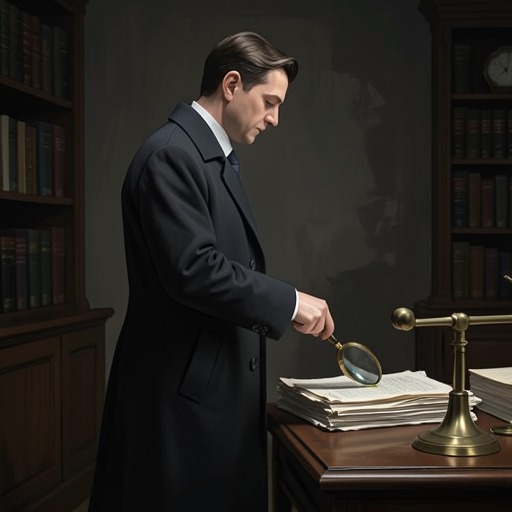
Heath Holmes
The Outsider (Stephen King Edition)Heath Holmes is a thirty-four-year-old Dayton resident and orderly at the Heisman Memory Unit, whose arrest for the murders of Amber and Jolene Howard appears to offer a solution to a brutal crime. But he dies before trial, and details that emerge through Holly Gibney’s inquiry make his case more than a separate investigation: his movements intersect with the Maitland family’s visit to the Memory Unit, while evidence associated with both cases later deteriorates. Holmes becomes a grim counterpart to Terry Maitland, and a measure of how little an apparent solution can settle.
Identity and Introduction
Holmes enters the account through the newspaper chronology Holly follows while investigating the Dayton murders. After the Howard sisters’ bodies were discovered, police announced that they were questioning a person of interest; two days later, they arrested Holmes. He was thirty-four, lived in Dayton, and worked as an orderly at the Heisman Memory Unit. The chronology supplies these ordinary identifying details just as the case seems to close around him, establishing a recognizable suspect without giving the reader direct access to his perspective.
His colleagues’ recollections complicate that public identity. Candy Wilson, who had worked with him at the Memory Unit, said staff called him Handsome Heath, partly in jest and partly because he was good-looking. She remembered him as nice and said that everybody thought well of him. Her recollection does not establish innocence; its importance lies in the gap between an agreeable workplace reputation and the crimes attributed to him. Candy’s rueful observation that one cannot know what is in another person’s heart gives the gap a chilling, everyday quality.
The Howard Sisters Case
The public chronology begins with the disappearance and deaths of Amber and Jolene Howard, two young sisters from Trotwood. Their deaths drew intense attention, and Holmes became the named suspect after police announced they were questioning a person of interest. Candy recalled that coworkers had heard about an earlier joyride arrest, but distinguished that incident from what Holmes was accused of doing in April. She said she could scarcely reconcile the allegation with the man she had known at the previous year’s Christmas party.
Candy also recalled Holmes telling colleagues that he was going to Regis with his mother to hold a memory service for his father, who had died a year earlier. She could not confirm whether he made that trip. What she did say was that Holmes returned and that people had seen him; she also recalled reports of gas-station surveillance showing him filling up. These details fed suspicion, but Candy did not know what vehicle appeared in the footage. Her speculation that it might have been his customized Tahoe, with its camper cap, remained speculation rather than established evidence.
A small date in Candy’s appointment book sharpened Holly’s comparison with the Maitland timeline. Candy remembered having her hair colored at Debbie’s Hairport and found the appointment recorded for April 26. That was the day Terry Maitland visited his father for the last time; the Maitland family flew home the next day. Candy’s date therefore connected her recollection of Holmes’s supposed trip with the precise period of the Maitlands’ visit, giving Holly a concrete point to set against the two cases’ apparent separation.
The Memory Unit Connection
Candy described a consequential detail that, she said, had not appeared in newspaper coverage. After the murders, police learned that Holmes had been inside the Heisman Memory Unit and searched the suites on B Wing, paying particular attention to Maitland’s. Their interest followed a janitor’s account: Cam Melinsky said he saw Holmes coming out of that area while Melinsky was washing the hallway floor, and noticed him because he slipped and fell.
The reported search produced a striking but secondhand clue. Candy said that her friend Penny Prudhomme, a nurse, had overheard a police officer discussing the search of B-5 on the phone. According to Candy’s account of that conversation, officers found blond hair in the room. The information reaches Holly through several people rather than through an official report, but its placement is pointed: Holmes had been seen leaving the area, Maitland’s suite drew special attention, and the reported hair was blond. The clue strengthens the sense of a connection without, on its own, specifying whose hair it was or resolving what happened there.
Holmes’s employment also provides the practical link between the suspect and the Maitland family’s visit. He worked as an orderly at the same Memory Unit where Terry visited his father. This overlap turns the date and room details into more than loose coincidence for Holly: they make the two investigations seem to touch at a particular place and time, even as the available accounts remain incomplete.
Arrest, Death, and Untried Case
Holmes survived his arraignment, unlike Terry Maitland, but never stood trial. He died by suicide in Montgomery County Jail on June 7, before the case could be tested in court. For Holly, this parallel became a confluence: two men associated with related murder investigations, both lost to the process before a trial could clarify the evidence. Holmes’s death ended the possibility of hearing his account or seeing the prosecution’s case examined in court.
His untried status matters to the evidentiary shape of the story. Candy’s recollections, the reported sighting at the Memory Unit, the blond hair reportedly found in B-5, and the gas-station surveillance all contribute pieces, but Holmes’s death leaves the case without a verdict. His apparent guilt is repeatedly treated as persuasive, yet the circumstances that might have been tested through testimony and cross-examination remain part of an unfinished record.
Parallel with Terry Maitland
The investigation later makes the parallel explicit. Alec Pelley argues that the outsider had made a mistake by failing to anticipate Terry Maitland’s attendance at a convention in Cap City. Most chosen scapegoats, Alec says, would be like Holmes, with weak alibis. The comparison casts Holmes as a more convenient target: unlike Maitland, he apparently lacked an alibi strong enough to expose the contradiction at the center of the other case.
The forensic aftermath extends that parallel. Bill Samuels tells Ralph Anderson that samples tested by Ed Bogan in the Serology Department at the General began developing white spots despite having no exposure to ultraviolet light, then degraded completely. The same deterioration occurred with the Heath Holmes samples held by Ohio State Police Forensics; photographs showed those samples disintegrating as well. The shared failure does not prove what happened in either case, but it frustrates the ordinary route to certainty. Holmes’s case therefore remains joined to Maitland’s by a chain of suspicious coincidences and compromised evidence, even after Holmes himself can no longer answer for them.